DRIFT DETECTION FOR PRODUCT TEAMS
The graph between
roadmap and code.
SpecGraph connects your product intent — product requirements documents, Slack decisions, meeting notes, acceptance criteria — to what engineering actually shipped, and flags the gaps before your users do.
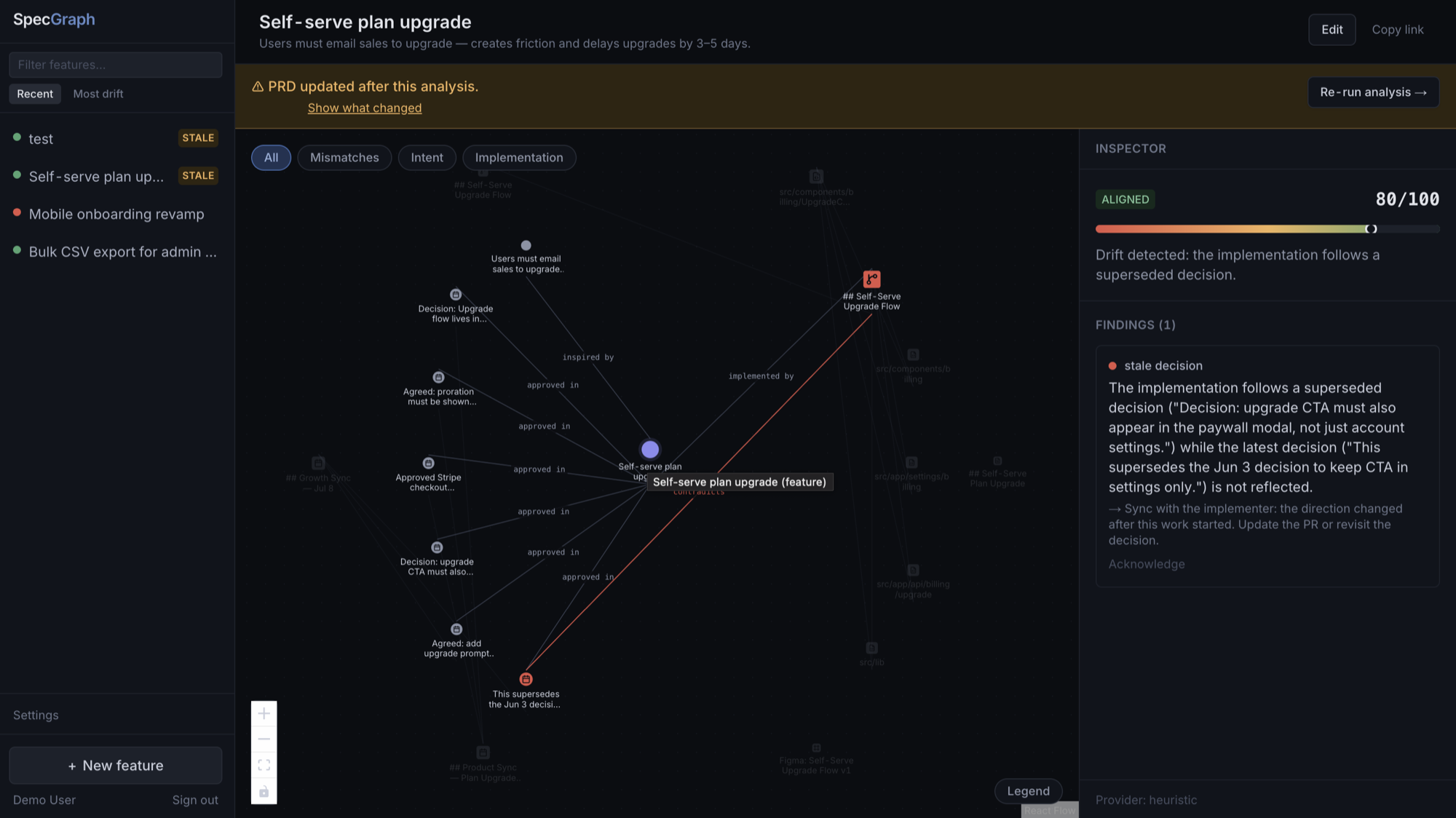
A live replay of a real analysis — intent on the left, implementation on the right, drift in red.
The spec says one thing.
The code ships another.
Decisions scatter
The real spec lives across requirements documents, Slack threads, and meeting notes. Nobody rereads them before merge.
Drift is silent
No test fails when a requirement is quietly dropped — or when scope quietly grows. CI is green either way.
You find out last
Misalignment surfaces in the sprint demo, the retro, or a support ticket — when it's most expensive to fix.
SpecGraph makes intent checkable: one graph per feature, a drift score, and named findings — before the merge, not after the retro.
One canvas. The whole story.
Features rail, drift graph, and an inspector with concrete findings — every claim traced back to the exact artifact that made it.
How it works
01
Add your intent
Paste or import a PRD, Slack decision, meeting notes, acceptance criteria — or connect GitHub, Linear, Slack, and Google Meet and let it arrive on its own.
02
Link the implementation
Point SpecGraph at the ticket and the pull request. It extracts what engineering actually built, in language product people understand.
03
See the drift
One graph per feature connects intent to implementation. A drift score and concrete findings show what's missing, what crept in, and which decisions went stale.
Ask Claude. SpecGraph answers.
SpecGraph ships as an MCP server — Claude Code and Claude Desktop query, update, and re-analyze your features mid-conversation. Your roadmap becomes something you can talk to.
Coding agents write more of your implementation every week — but they can't read your team's intent. SpecGraph is the new way agents stay current across the product and implementation lifecycle: they read the requirements, check drift after every change, and file decisions back — autonomously.
Has "Self-serve plan upgrade" drifted since the requirements doc changed?
specgraph — get_drift_report("Self-serve plan upgrade")
running…
score 72/100 · needs_review · 1 finding · requirements doc changed after last analysis
analyze_feature
Re-run the drift analysis from chat — no tab switch, no copy-paste.
add_artifact
Paste anything — a link, a ticket, a thread. SpecGraph figures out what it is.
list_connections
See what's wired up — link a new feature to a repo so PRs auto-attach.
Catch drift before it merges
A drift score below your threshold fails the check — the same analysis, wired into GitHub Actions with one API key.
- uses: ./.github/actions/specgraph-check
  with:
    feature-id: 8f3c…d2a1
    api-key: ${{ secrets.SPECGRAPH_API_KEY }}
    threshold: "70"
Every new account starts with a worked example.
Sign up and explore a fully analyzed sample feature — no setup, no API keys required.
Create your account